
What is the minimum budget to buy a good investment property?
A "good property" is only defined once the household's situation and the purpose of the investment are set. Taking the example of a 30-year-old household with an annual income of ¥6 million preparing for retirement funds, this piece estimates how much to borrow, how much to pay, and what remains. All figures are assumptions.

BENERU writes for readers who live in Japan. Taxes, loans and the other rules described here are those of Japan, and they assume a resident of Japan.
This page is a translation of the Japanese original. If the two differ, the Japanese original prevails.
I answered a question like this on a Q&A site.
If I were to buy an investment property, what is the minimum amount I need to buy a good one?
Strictly speaking, you see? The proper answer is to write that there is no way to answer without a purpose and a "definition of a good property."
But if I said that, I would never get to write anything, so I will set the conditions myself and write.
Please use it as a reference of some kind.
If you are reading this and want to think about it under your own conditions, after reading this piece, it would be good to write out your own assumptions in the same way and make the definition clear.
I will set the conditions myself
You have these attributes. Well, I don't actually know, do I? You didn't write anything.
Age 30, married; 8 years at a major company; annual income ¥6 million; renting your home; 1 child, age 3; both spouses' parents alive and well; financial assets of ¥3 million, all in savings
The purpose of the real estate investment is to prepare for retirement funds, and you started considering it after an article you saw in a money magazine the other day.
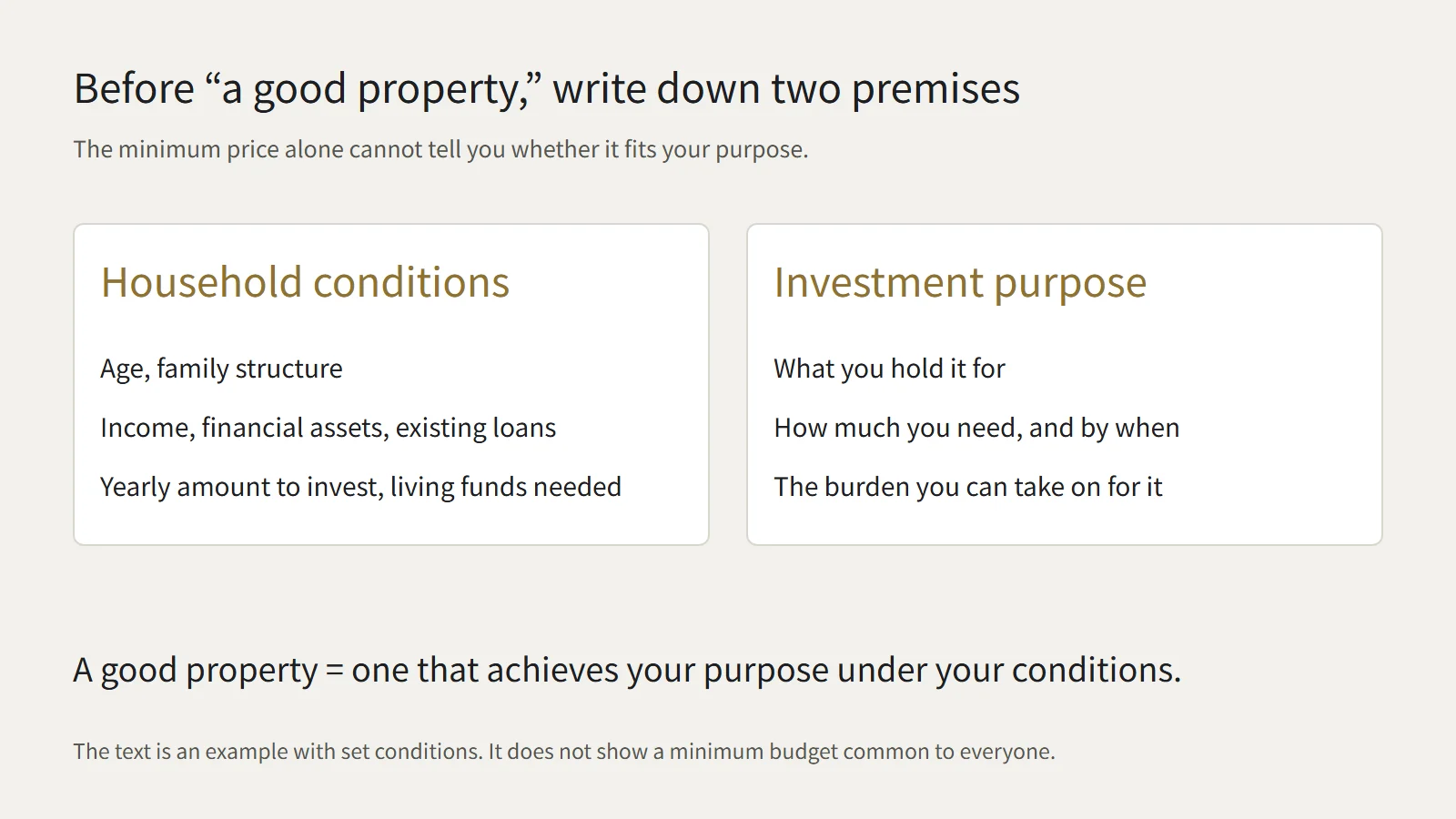
And a good property means an investment product that can achieve that purpose.
From what I have written so far, please grasp 2 important points.
One. A good property differs depending on your household situation.
Two. A good property differs depending on the goal of your investment plan.
Now, if a person in this household situation considers real estate investment to dispel worries about old age, what should they buy?
How much to borrow, and what to cover
A person with an annual income of ¥6 million can borrow roughly ¥100 million. With package loans, it is common to think of the total borrowing as annual income × a multiple.
Lenders may look at around 8 to 16 times, so I take the maximum to be about ¥100 million. (In practice, lenders also screen by the debt-to-income ratio, which looks at what share of annual income the monthly repayments take, so the amount you can borrow may be smaller.)
I will think about how the properties you can buy with a ¥100 million loan can resolve worries about old age.
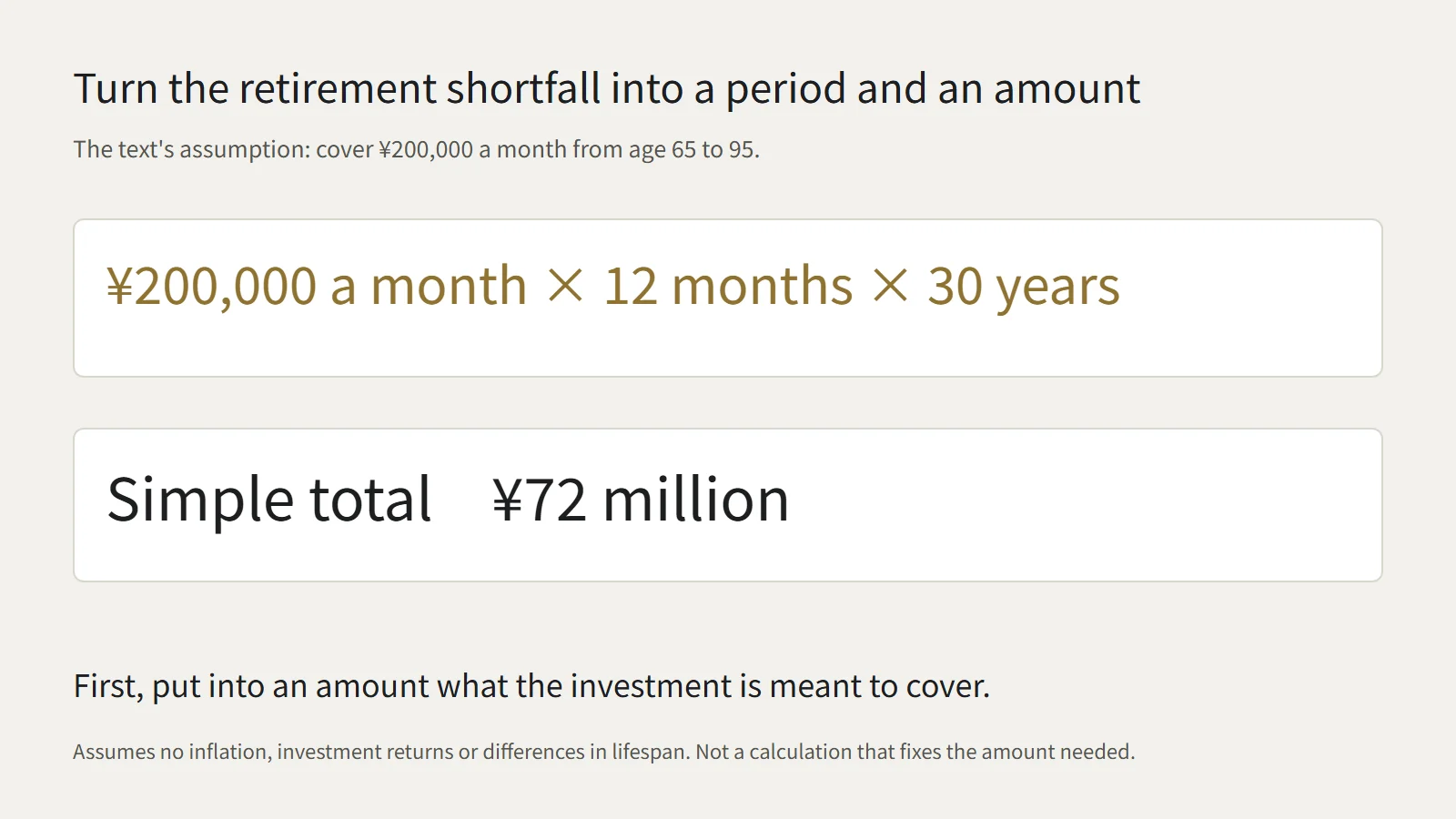
Worries about old age are concerns about living funds. It depends on how much you can count on your pension, but let's say you can expect ¥150,000 to ¥200,000 from the employees' pension.
In the Japan Institute of Life Insurance's 2025 survey, the result was that a comfortable retirement costs ¥391,000 a month for a couple. If you expect close to ¥200,000 from the employees' pension, the shortfall is about ¥200,000.
Let's take 65 as the retirement age, and have you die at 95.
Then the provisional shortfall is 20 × 12 months × 30 years = ¥72 million.
So in total, with ¥72 million you would have no worries.
A comfortable retirement refers to a level of living where you can freely enjoy things like traveling now and then and indulging in hobbies.
Applying a "good property"
Now, on this premise, let's think about what a "good property" is.
Having ¥100 million of credit means you can buy 4 condominium units at ¥25 million each.
Even if the rent after expenses is ¥70,000, that is an income of ¥280,000.
Well, realistically you won't necessarily hold the same properties for 35 years, but starting at age 30 with 35-year loans, you could own fully paid-off properties.
That covers ¥200,000 or more in monthly rental income.
Taking the out-of-pocket cost per condominium unit as ¥10,000 a month, for 4 units: ¥40,000 × 12 months × 35-year loan = ¥16.8 million.
For expenses such as equipment wear, renewal costs, and advertising costs, plus the stress of rising repair reserve fund contributions and declining rent, provisionally take a burden of ¥4 million in total over 35 years × 4 units = ¥16 million.
So with total spending of ¥32.8 million, you own 4 condominium units as assets at full repayment.
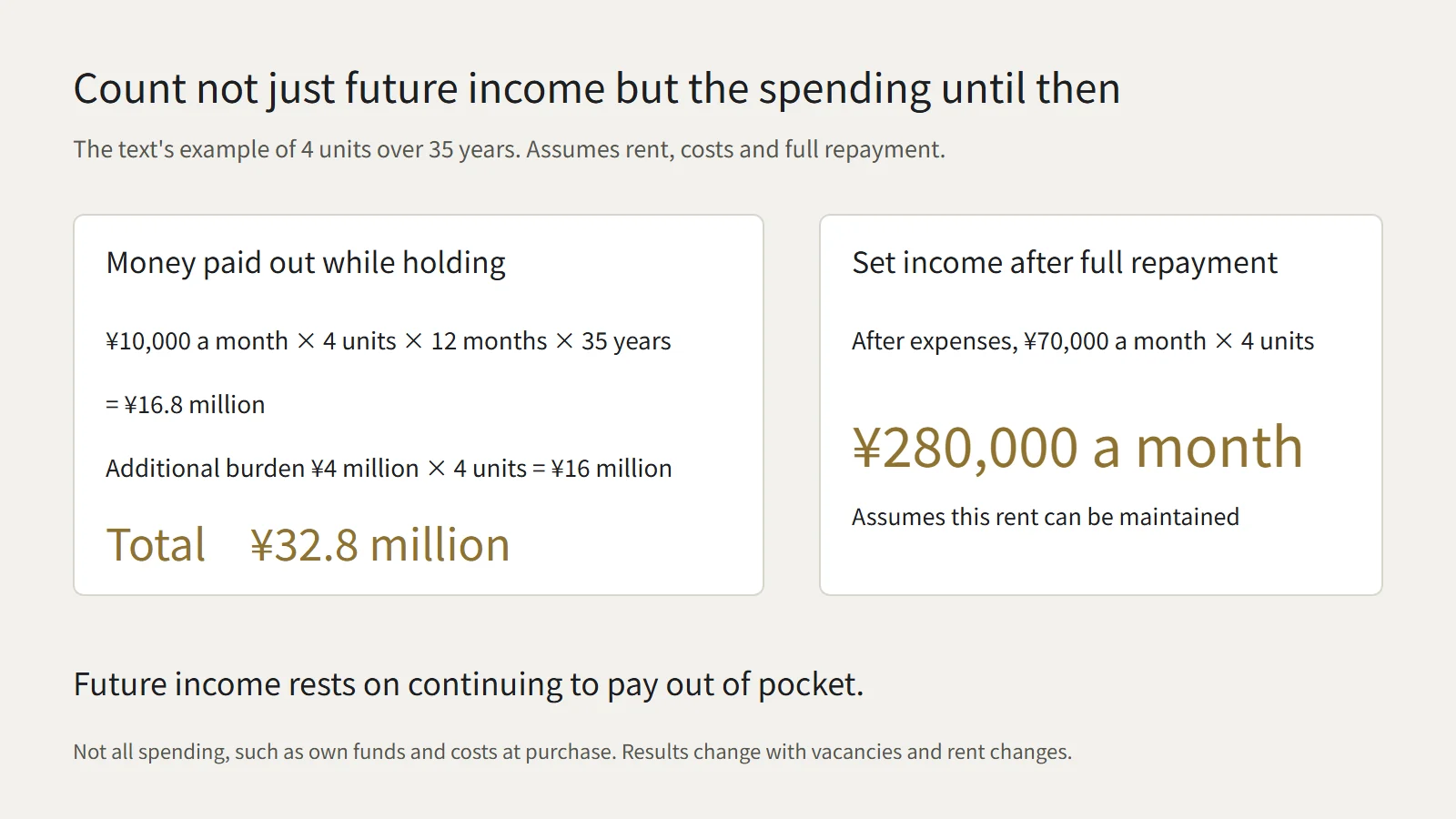
If you hold them until 95, the originally planned shortfall of ¥72 million is covered by income in the first place, and on top of that you still own the condominiums themselves as assets.
Well, it is a broad outline, but this is what the world calls condominium investment.
Better not to dream
This is not something you can understand in about 2,000 characters, so please just take this kind of article as a starting point, but I will note only the important points.
As you can roughly imagine from what I have written here alone, the content is "you actually pay quite a lot of money." It is not some "dreamlike story where wealth falls into your hands while you do nothing and bear no burden."
However, for all that, there is room to steadily secure yourself against future worries.
Low-yield condominiums are, unexpectedly, the better choice as a steady effort for salaried households.
It is better not to dream.
Many readers are probably of the parents' generation, so please teach your children. Don't dream.
If you want to hold with a positive balance
Now, let me touch on an even more dreamlike story and wrap up.
If you want to hold a property with a positive balance, you will be taking risk, so be prepared.
Over the past ten-plus years, condominium prices in urban areas have been on an upward trend. In the Ministry of Land, Infrastructure, Transport and Tourism's real estate price index, condominiums nationwide stood at 225.1 in December 2025, with 2010 as 100. It is only natural that many people succeeded in real estate investment during that time.
That does not mean the market will be good from here on. Of course.
Taking yield means taking risk.
And the "good property" that amateurs typically imagine does not exist. Please think of it that way.
"But there are off-market properties traded only among dealers, aren't there?"
Yes. There are. But you could not go without a loan contingency clause, put in 10% as earnest money, and pay the penalty if something went wrong, could you?
You cannot have only the benefits with no burden. Really, you should stop dreaming from watching too much YouTube and the like.
I think far too many people dream about apartment building management.
It is not that it is bad, but many people take it on while still amateurs, so it would be better to study.
Now, I have written about "good property" and about costs.
And if you want to think about "your own case," it would be good to start by writing out your "household situation" and "investment purpose." Well then.