
If I do real estate investment, should I use a loan?
The point of real estate investment lies in being able to invest using borrowing. This is called "using credit." However, not many people can get financing. I also lay out population projections, average salaries, and the rules on credit information.
BENERU writes for readers who live in Japan. Taxes, loans and the other rules described here are those of Japan, and they assume a resident of Japan.
This page is a translation of the Japanese original. If the two differ, the Japanese original prevails.
I answered this question on a Q&A site.
When doing real estate investment as asset management, is it better to use a real estate investment loan?
Through this question, I would like to convey the idea of "using credit" widely to those who are interested.
I feel that income properties have gone mainstream, so much so that there is even the term "salaryman landlord."
However, more people coming to know about it also means more cases of people taking it on without studying, and as a result the vague anxiety about the industry—that real estate is scary, as always—has not gone away.
Real estate investment means investment using real estate.
This is also called "income property" or "rental management," and they all mean the same thing.
The point of running a rental business in Japan
When considering real estate investment in Japan, what exactly are the merits?
There are several things you should understand clearly.
Japan's population is projected to decline. In the projection by the National Institute of Population and Social Security Research, the population, which was 126.15 million in 2020, is expected to fall to 87 million by 2070—a decrease of as much as 3 in 10 people.
In addition, the decline in the working-age population due to the falling birth rate and aging population is also seen as a problem.
Economic development can't be called remarkable either. Rental demand arises when businesses expand, workers are needed, and that becomes a market.
When the total amount of work is not increasing, rental demand increasing is, in principle, unthinkable.
In that situation, what is the point of going out of your way to run a rental business in Japan?
People taking on real estate investment in this real estate market are by no means pinning their hopes on the future of Japanese real estate.
If anything, you could say it is drawing attention precisely because the domestic market is unchanging.
The idea of using credit
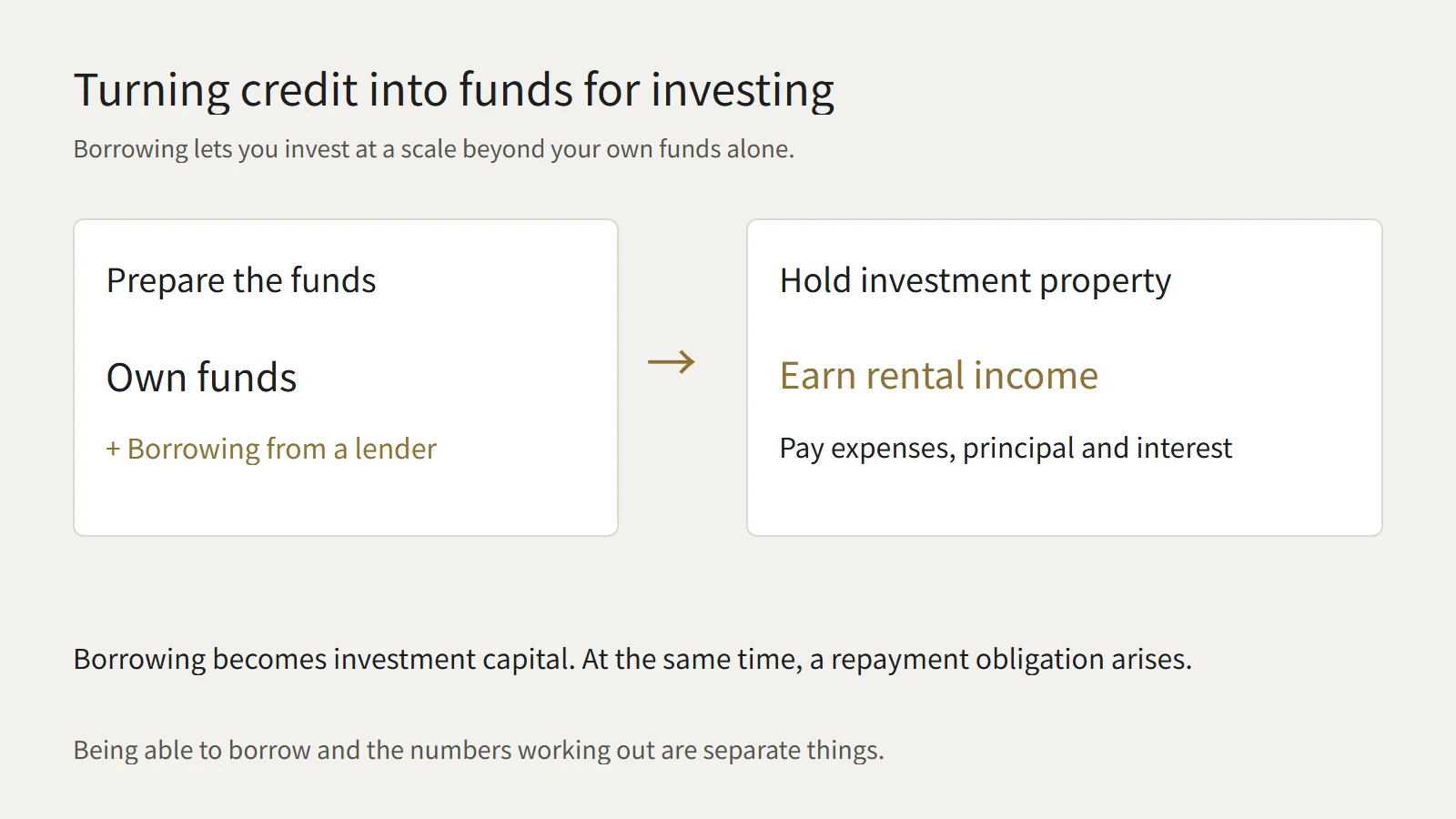
The appeal and point of real estate investment come down to the part where you can invest using borrowing.
This is called "using credit."
As of the time of writing (2025), Japan's lending interest rates are overwhelmingly low even by world standards.
That means the downside of debt is extremely low.
The idea of raising investment returns by using these low funding interest rates is using credit.
People doing real estate investment are, so to speak, doing real estate investment in order to make use of debt.
It is not that they expect Japanese real estate prices to rise, nor that they love real estate, nor that rental management is especially profitable.
Being able to invest with other people's money is the greatest merit.
Suppose the interest burden on the funds raised is 2%; even if the yield of the investment product is 4%, it can produce investment profit that exceeds the interest burden.
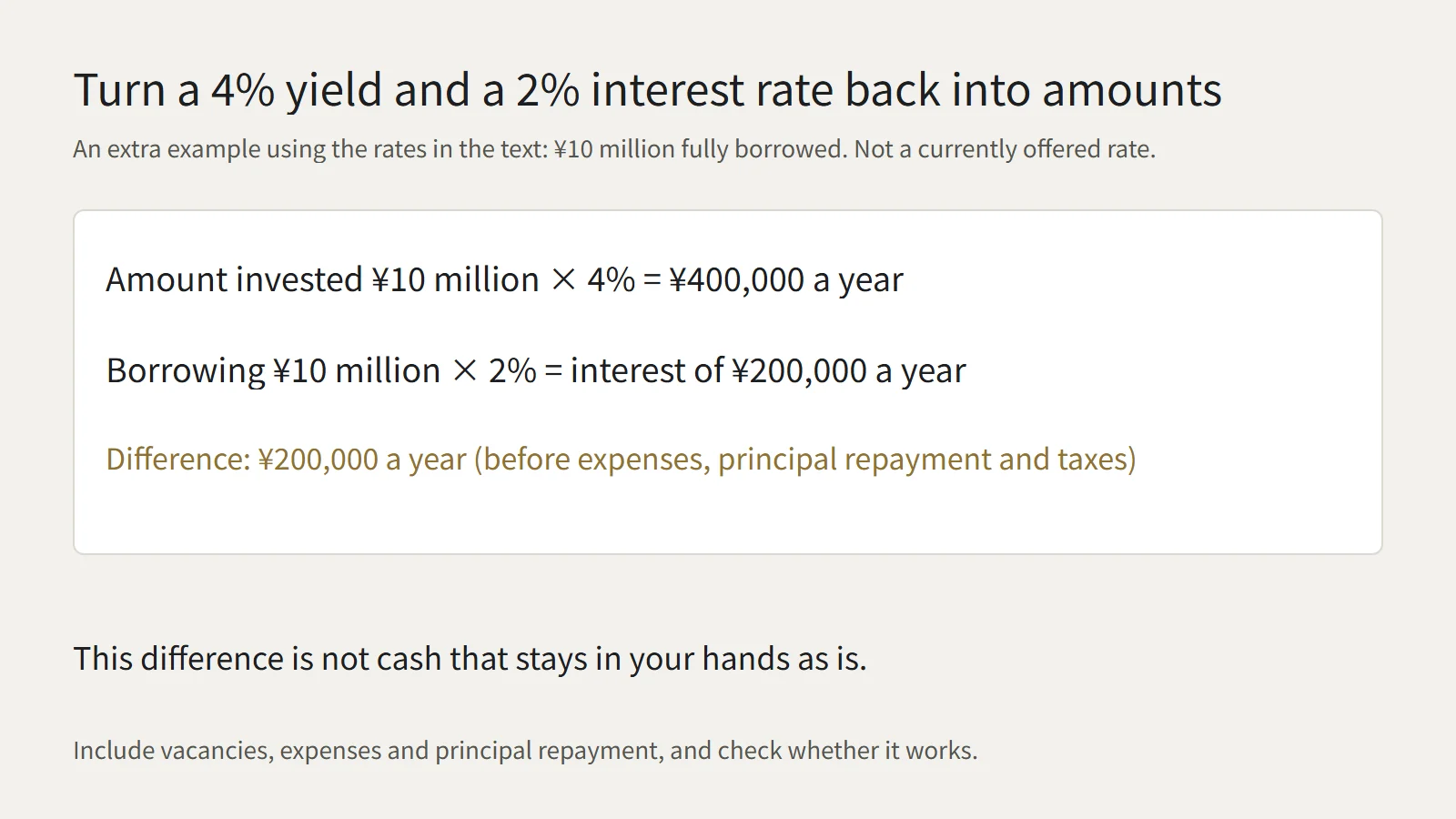
And using borrowing means it is not your own funds, so it does not mean you can't invest until you have saved money first.
In today's society, even saving up the investment funds themselves is difficult.
Amid that, it is reassuring that this is an investment you can take on if you are able to get financing.
Few people can get financing
However, getting this financing is a high hurdle to begin with.
It is something easily misunderstood in the world, but "almost all people" cannot get financing, so this story doesn't concern them in the first place.
As a rough guide as of 2025, you need an annual income of at least around ¥5 million and an employer of reasonable size.
Also, being in a state of health that allows you to join group credit life insurance (dantai shinyō seimei hoken), and having a sufficient loan term—that is, age. Real estate investment can be taken on only by people who clear these conditions. Having no blemishes on your personal credit information is also an important condition.
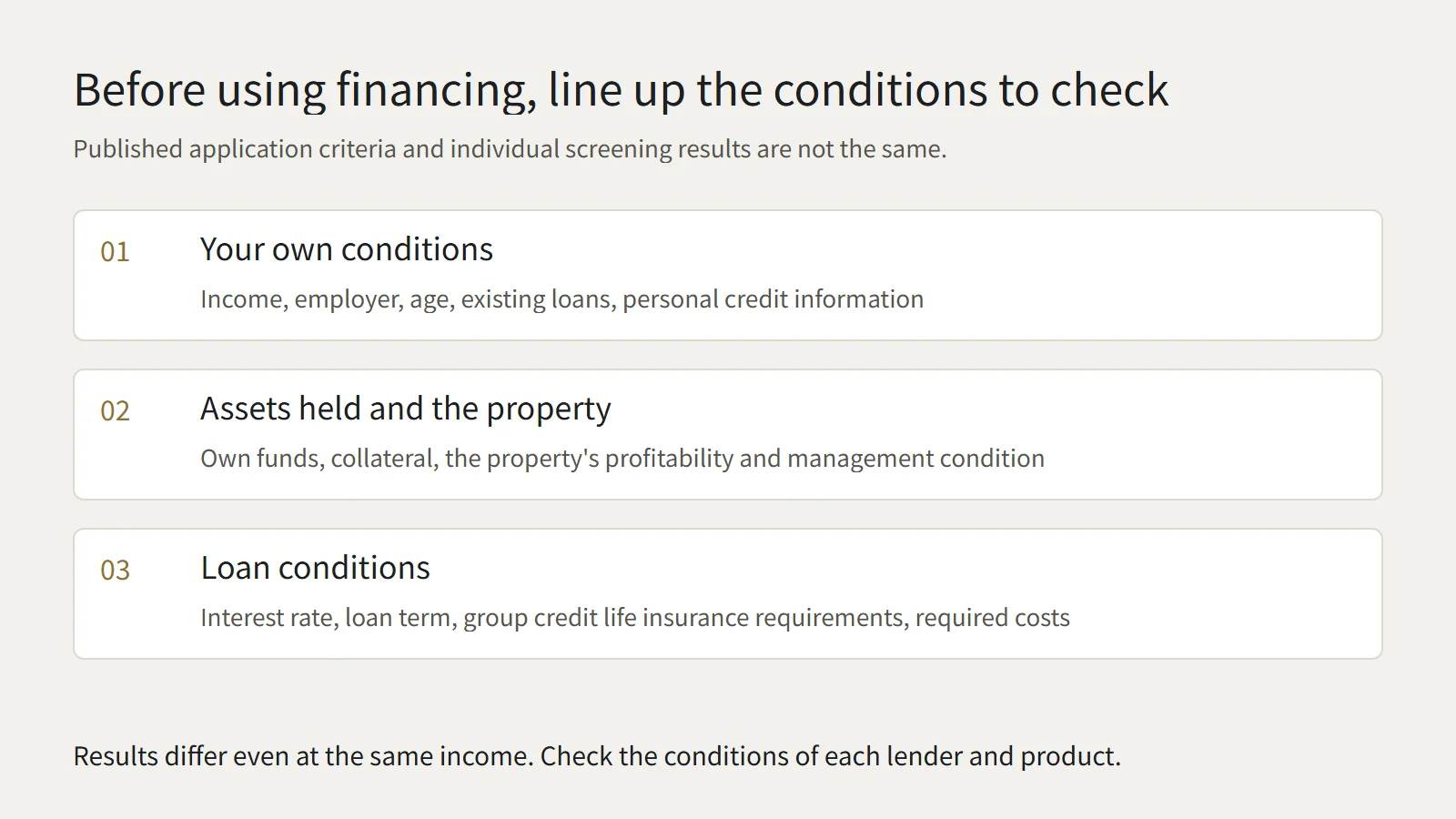
Those who are paying for a mobile phone handset in installments and have been late with a payment. Payment status is recorded in credit information, and if there is a delinquency of 61 days or more, it remains as default information (an "adverse event").
If that happens, you can't take out a loan. I think financial defaults have increased as credit payments and installment plans have become easier. Please be careful.
There are of course exceptions.
Having a property or land that can serve as collateral, having a shinkin bank you do business with—financing does not come in only one form.
However, such cases are probably extremely few.
After all, for most people it is a story that doesn't concern them in the first place.
In the National Tax Agency's survey, the average salary for 2024 (Reiwa 6) is ¥4.78 million. People with an annual income of ¥5 million or less exceed 60%.
Somehow only the image of real estate investment has taken on a life of its own, but structurally it cannot become a particularly mainstream investment.
"There are an awful lot of people making noise, but very few who can actually do it."
You could say that is what real estate investment is.
If you include investing in detached houses and the like, you could say it is possible to get into, but I think you had better consider that a somewhat different story.
This is not a denial or criticism; my understanding is that renovated detached houses are a separate genre.
Summary
To answer this question in summary, you could say that only by using a real estate investment loan can you make use of its merits.
"Building assets by making use of a loan is the essence of real estate investment."