
Where does the rent go?
Where does the rent a tenant pays go? Using a fictional example of ¥500,000 a month, we sort out the differences between expenses, interest, principal repayment, and cash left over.

BENERU writes for readers who live in Japan. Taxes, loans and the other rules described here are those of Japan, and they assume a resident of Japan.
This page is a translation of the Japanese original. If the two differ, the Japanese original prevails.
Good day.
Where does the rent a tenant pays go after that?
This time, I will follow only that.
The following is a fictional example for illustration.
A whole building with 10 units. At full occupancy, total monthly rent is ¥500,000.
The purchase price was ¥75 million, of which ¥60 million is borrowed at a 3% interest rate over 25 years. The monthly repayment is ¥284,527.
Let us split this ¥500,000 by where it goes.
- Lost to vacancies and late payments: ¥25,000 (5.0%)
- To the property management company: ¥23,750 (4.8%)
- To maintaining the building (utilities, cleaning, and repairs for common areas): ¥50,000 (10.0%)
- To the local government (fixed asset tax): ¥40,000 (8.0%)
- To the insurance company: ¥5,000 (1.0%)
- To the bank (interest): ¥150,000 (30.0%)
- Reduces the debt (principal): ¥134,527 (26.9%)
- Cash left in hand: ¥71,723 (14.3%)
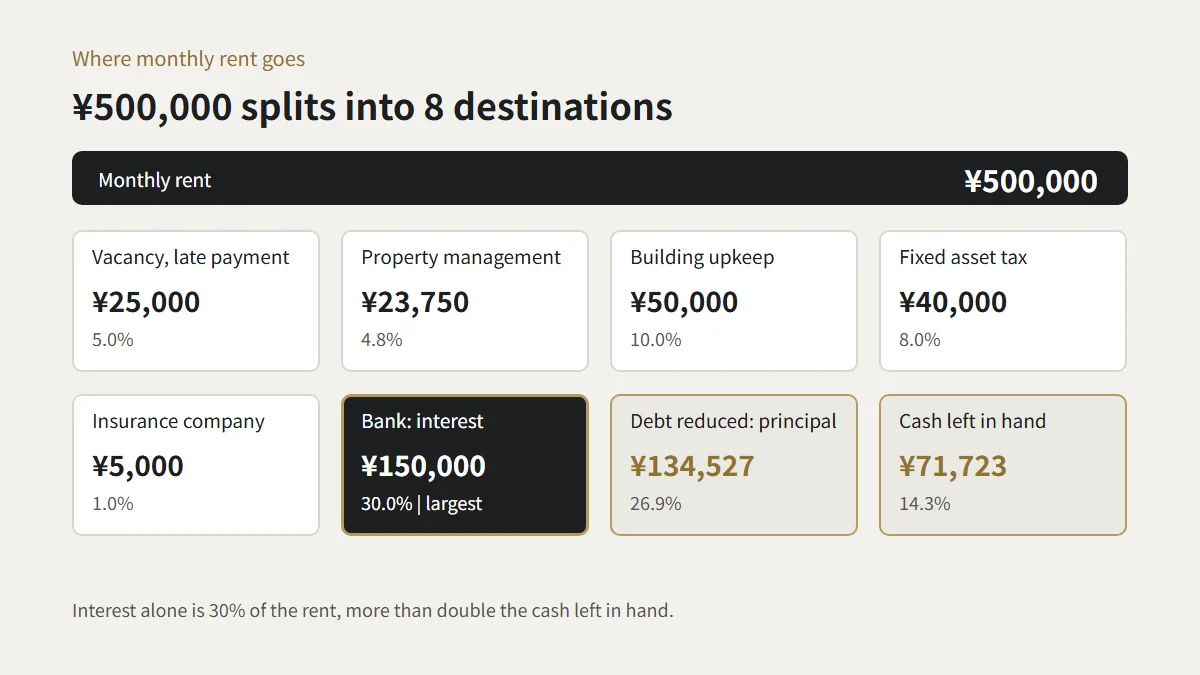
The total is ¥500,000.
The largest is the interest to the bank.
30% of the rent. More than double the cash left in the owner's hands.
However, "going out" and "moving" are different
Here, let me separate one thing.
The ¥150,000 that went to the bank does not come back. It is the price of borrowing the money.
The ¥130,000 of principal, on the other hand, is different. It is paid to the bank, but the owner's debt goes down by that amount.
It disappears from the bankbook, but it remains in the owner's assets.
Adding this, the owner's share is
¥71,723 + ¥134,527 = ¥206,250 (41.2%)
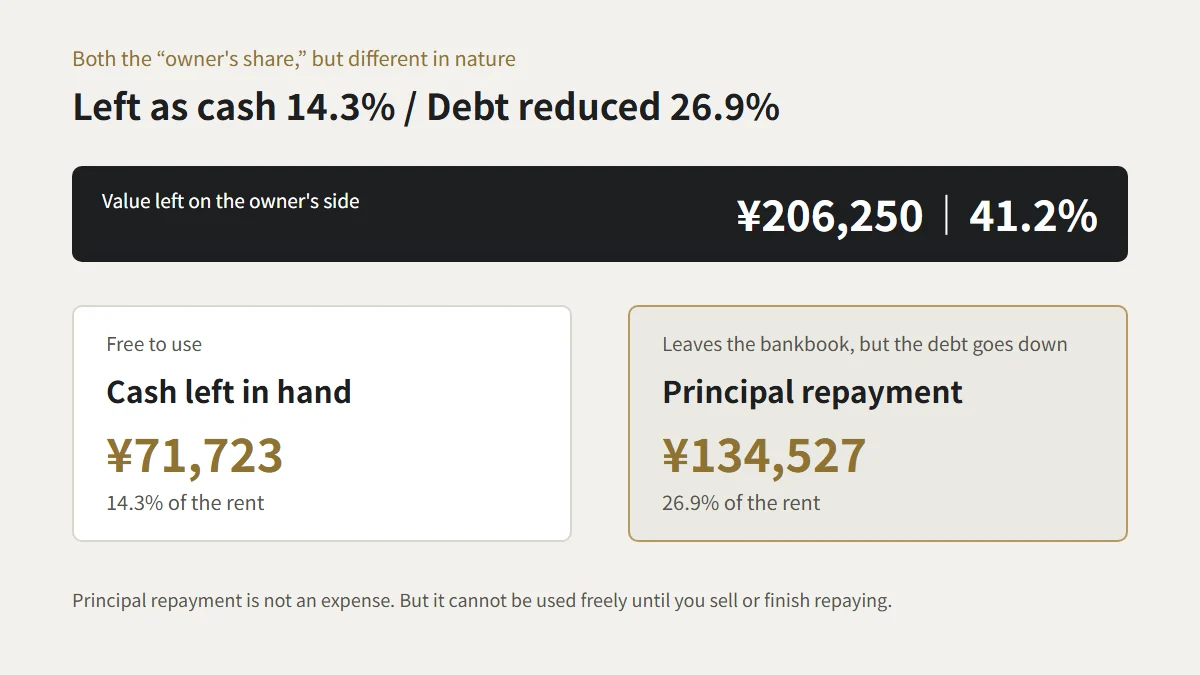
40% of the rent. Seen that way, it looks like a decent number.
But only 14.3% of it can be used freely. The rest cannot be taken out until you sell or finish repaying.
If you mix these two, the books and the bankbook stop matching.
How does it look from the tenant's side?
Let me change the angle.
Of the ¥50,000 I pay, about ¥15,000 goes to the bank, and about ¥13,000 goes toward repaying the landlord's debt.
Pointing at this, people sometimes say "tenants are paying off the landlord's loan."
As numbers, that is true.
But in return, the tenant gets a place to live. If they bought, the down payment, acquisition costs, fixed asset tax, and repairs would all be on them. Instead of carrying those, they pay monthly.
They can also move out at any time. The landlord cannot stop repayments even when a unit is vacant.
It is not a question of who is losing; it is an exchange. Still, I think it does no harm to know the structure itself, that 40% of the rent becomes the landlord's assets. For those who rent, and for those who let.
Items you can reduce, and items you cannot
Let us look at the list of destinations again.
What you can move with your own effort is about the vacancy rate, the management fee, the cost of repairs, and how you buy insurance.
All together, a little over 20% of the rent.
Fixed asset tax cannot be moved. And the largest item, interest, is mostly decided at the time you borrow.
In other words, the range you can change by effort after buying is narrower than you think.
The stage where you decide the interest rate and the term ends up being the biggest decision.
Working hard on vacancies after buying certainly has meaning. But what moves with that is the 5% part.
We do not often look closely at our pay slips.

We look only at the amount at the very bottom.
Once in a while, looking further up, the gap from the gross amount is a little surprising. The items lined up there are deducted every month, yet we cannot name them exactly.
We know they are deducted. How much is deducted is written there, if we look.
We just don't look.