
Why don't wealthy people buy many houses and live on the rent?
Many wealthy people do run rental businesses. But rather than buying many detached houses, most of them own condominium buildings using borrowed money. This piece covers the difference between the wealthy and investors, and the idea of running a low yield on a large amount.
BENERU writes for readers who live in Japan. Taxes, loans and the other rules described here are those of Japan, and they assume a resident of Japan.
This page is a translation of the Japanese original. If the two differ, the Japanese original prevails.
I answered a question like this on a Q&A site.
Why don't wealthy people buy 10 to 20 houses and live on the rental income?
The question seems to be an old one, but I am writing in case someone has the same doubt today.
As you say, there are plenty of wealthy people who run real estate rental businesses. So the doubt is resolved. Wealthy people do earn rental income. The end. Well, that is a bit too blunt.
Not many detached houses
That said, few of them buy houses. A "house" means a detached home, and in the actual business of renting out real estate, it is a category that takes a lot of work. It is not a product for the wealthy. You hear about vacant houses in the news, but unless someone really loves real estate, investing in detached houses has a high barrier and is difficult, so they probably won't take it on.
I think far more people take on condominiums.
With condominiums, the work drops dramatically. If you consolidate your rental management companies, you can operate with almost no burden on the owner, and there are quite a few owners running rental businesses of 100 units or more.
If you buy with cash, the yield is not high
By the way, from the expression "wealthy," I take it the question assumes investing with cash.
In that case, the yield of a rental business can hardly be called excellent.
It varies, but looking at the stable yields the wealthy consider, properties in Tokyo where resale value can be expected trade at yields of around 4% to 8%.
That means investing ¥1 million for 1 year produces a profit of ¥40,000 to ¥80,000. A rental business also has separate expenses, so the return drops a little further.
These days, that kind of yield is within reach of investment trusts too.
Considering the work of registration transfers and management and the hassle of buying and selling, many people would choose financial products other than real estate if the yield is about the same.
In Japan, where the declining birthrate and aging population are much talked about, the real estate rental business does not look all that attractive.
The appeal lies in borrowing
So why do wealthy people who run rental businesses do it?
The appeal of a rental business lies in doing it with borrowed money.
Wealthy people probably also own collateral, so they can borrow several times their own capital.
In other words, if you put up a condominium you bought with cash as collateral, you can buy more condominiums.
This is called applying leverage. It is the principle of the lever, the kind you understand by picturing a seesaw. As for which part of the lever principle means investing with borrowed money, you will just have to grasp it "roughly." If you start thinking "but the energy is balanced, isn't it?", it gets confusing, so let's not.
With bank financing, even if your own assets are ¥1 billion, you might be able to borrow ¥3 billion.
Then the amount you are investing jumps to ¥4 billion.
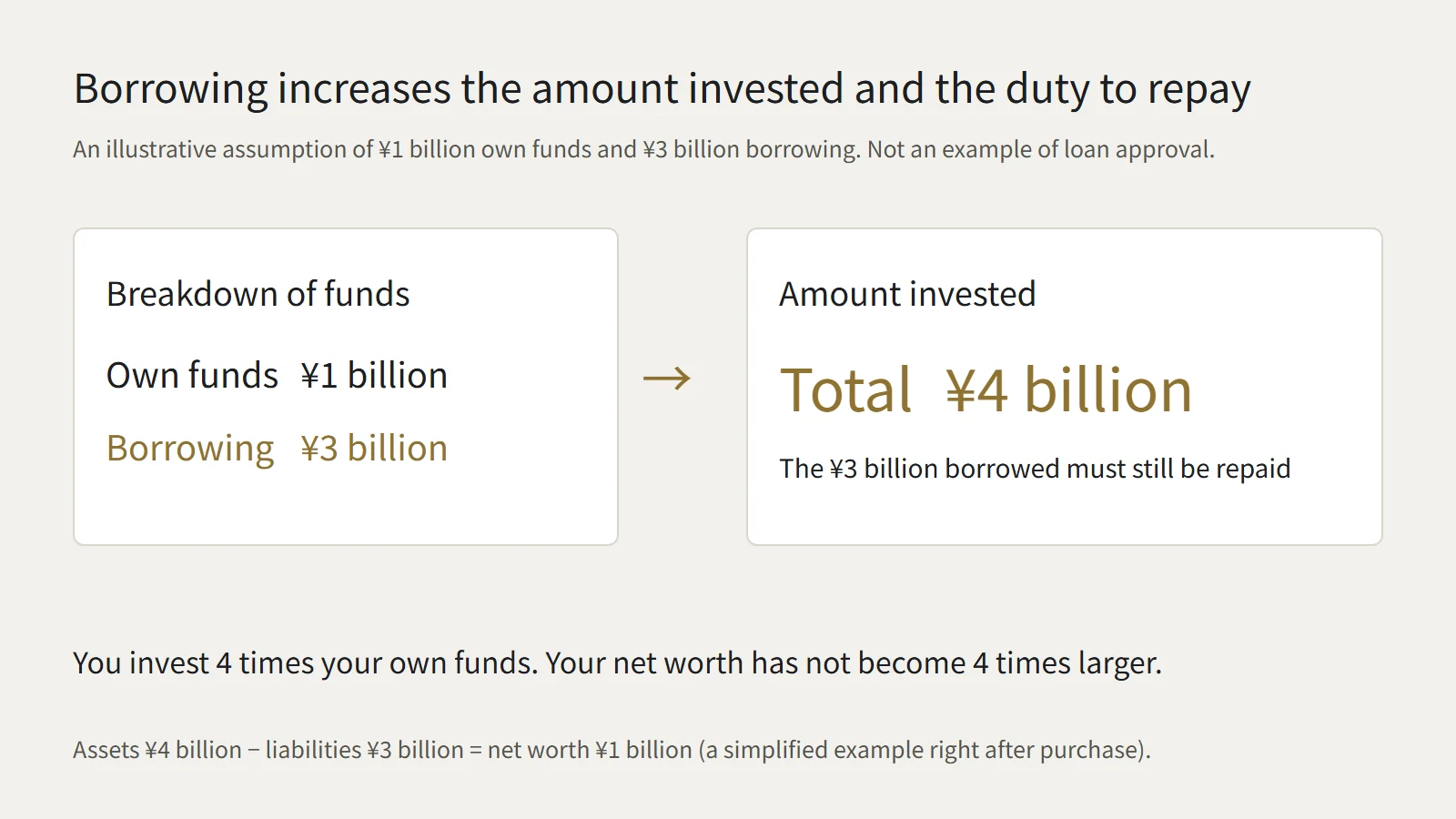
This can produce a larger profit than investing ¥1 billion.
This way of thinking is possible because interest rates in Japan are low.
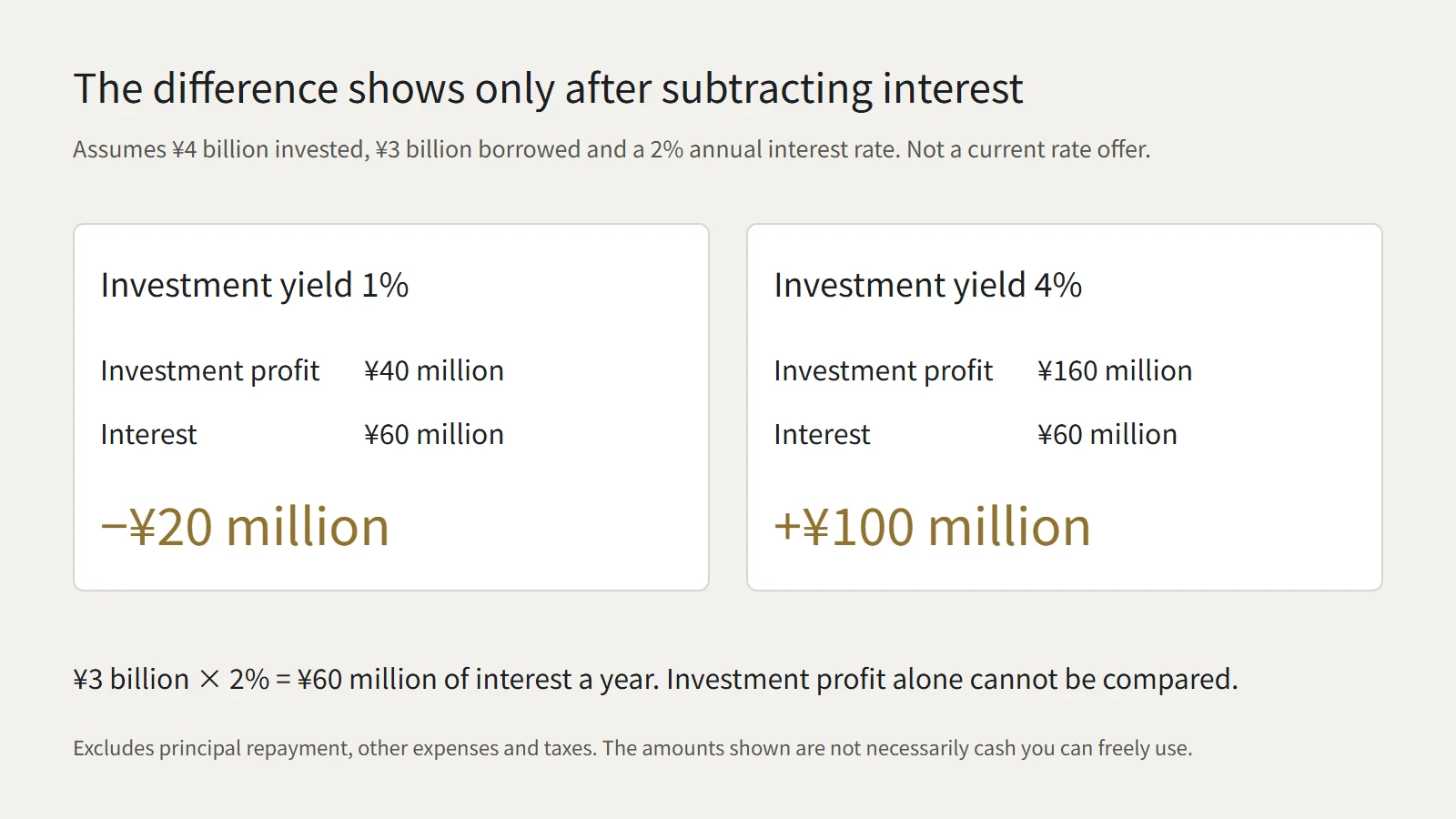
At the time of writing (2025), secured loans could be obtained at about 2%. If interest rates rise, this gap narrows.
As mentioned, even in Tokyo you can expect yields of 4% to 8%. If investment profit remains in hand even after paying the borrowing interest, there is value and meaning in applying leverage to increase the amount invested.
The wealthy do not take risks
I think many people imagine that the wealthy make forbidden-move investments that ordinary people cannot understand, but most real wealthy people make surprisingly ordinary investments. That is because if the amount invested is huge in itself, a high yield is unnecessary.
Investment return, the yield, comes from the correlation between risk and return.
Making money means taking risk.
And the investments the wealthy choose do not take risk. Low risk, low yield. Putting an enormous amount into investment products like that is the investment stance of the wealthy.
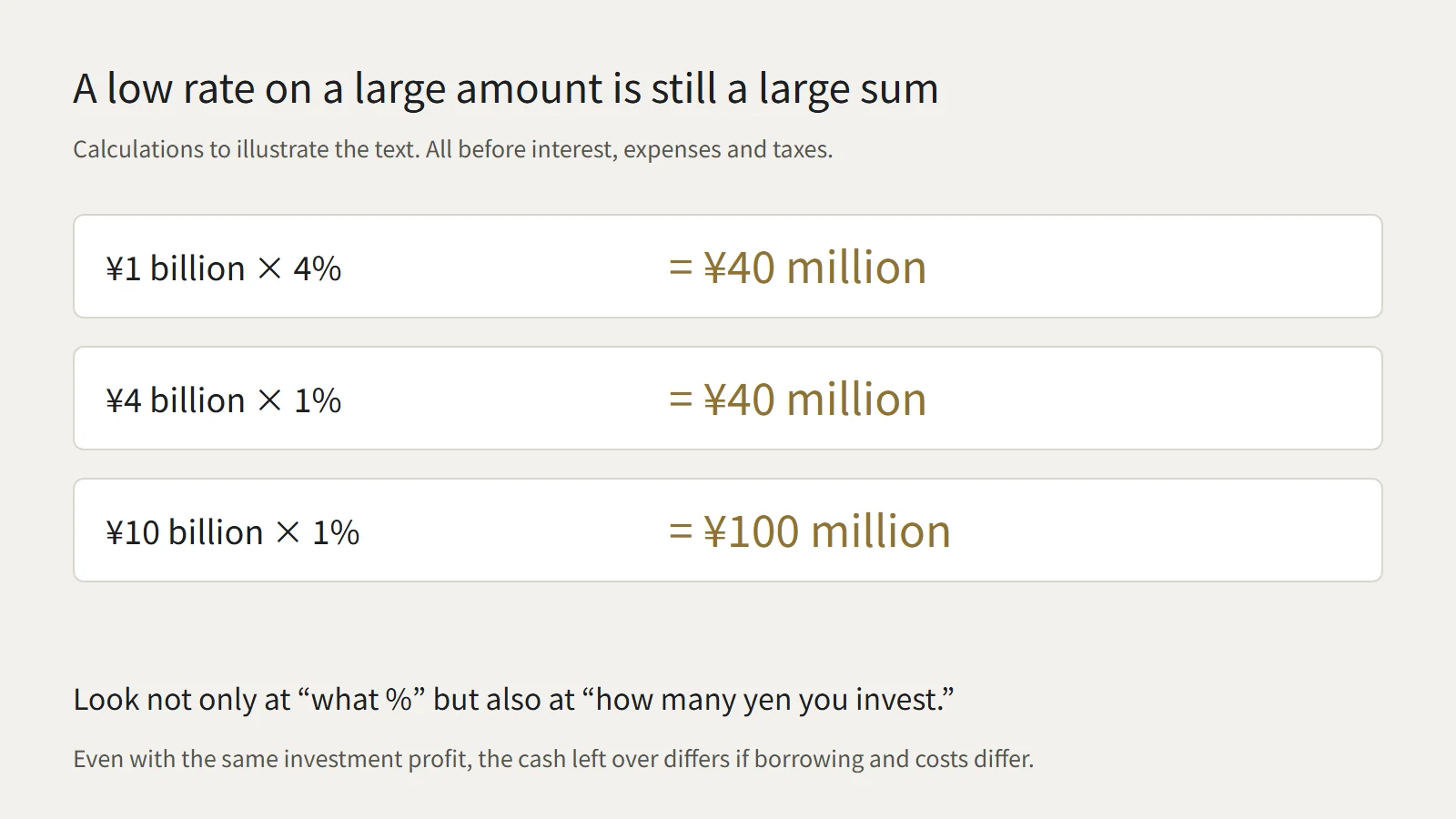
Even an investment yield of just 1% is a profit of ¥100 million a year if the amount invested is ¥10 billion.
An investor with ¥1 billion in assets who invests ¥1 billion and averages 4% earns a profit of ¥40 million.
If you invest ¥4 billion with leverage, 1% gives the same ¥40 million profit.
Low-risk investments have low yields. Conversely, a low yield does not necessarily mean low risk, though.
Many wealthy people avoid risk and build their portfolios mainly around hedging risk with low-yield products.
For most of the past 30 years, Japan has been in a state you could call disinflation, and people were able to protect their assets just by keeping them roughly flat.
Today it is said that you can protect your assets with an average of about 4%, but who knows.
What many ordinary people should learn from this question is that the people called asset holders or the wealthy take surprisingly little risk.
The idea many people dream of, "they must be making big profits from investing," is an illusion.
People who earn investment gains through high-yield investing are referred to separately as "investors."
For income property, from an "investor's" point of view, I suppose around 12% is the yield they consider. Honestly, I find that aggressive, but that is investors for you.
The wealthy, asset holders, and investors may look alike, but they are different things. Some people fall into both, so they tend to be confused, don't they?
Looking back
Now, let's look back at the question and finish.
There are plenty of wealthy people who run rental businesses.
Among them, many in particular use leverage and invest with bank capital.
The wealthy dislike risk, and invest in the ordinary financial products and condominiums we all know.
People who take on risk to make a profit are distinguished as "investors."
I think quite a few people hold illusions or assumptions about this, so it may be good to just keep it in mind at the level of "huh, is that so."
"Trying to copy the wealthy and carelessly following investors into high yields." Please take great care that this does not happen to you. Investing in detached houses is not a standard move of the wealthy.